ES Independent Column – Theo Jackson

In my novel, Murder in the Ozarks, Andy attends church one Sunday morning. “A tall man with a crew cut and black-framed glasses met Andy at the door, welcomed him by name, and handed him a photocopied program.” That line is my earliest recollection of Theo Jackson, handing out bulletins Sunday mornings before church when I attended with Granny. He knew everybody, and everybody knew him.

Theo was a direct descendant of the pioneer doctor Alvah Jackson, the man who many consider the founding father of Eureka Springs. Theo Jackson made a big impression on me. He had a large farm in the Rock Springs area east of Eureka Springs and he was a man of stature in the community and in his church. I was always impressed with how he carried himself with both humor and dignity. We once attended one of his mountain oyster parties and he was a gracious host.

Theo is someone whom I regret that I’ll not have another conversation with. In fact, I feel like he and I started some conversations that were still in play; conversations that we never finished. The last time we talked was in the barber shop and we continued a conversation we’d been having for twenty years about coyotes and wolves.

We lived on Rock Springs Road at one time and Theo was a neighbor. We had a half-grown Anatolian Shepherd pup named Frost and I was concerned about Frost getting along with Theo’s dog. Theo pulled in one day and his dog jumped out of the truck. Frost was probably 80 pounds then and put the dog back into the truck. I apologized, but Theo just said that Frost was doing his job. Over time, Theo grew to think a lot of Frost. He said that he liked to drive by and see Frost standing out with his cows in the pasture because that meant there were no predators around. After we moved to the hollow, Theo called a couple of times just to ask how Frost was doing.

Theo Ulysses Jackson died August 1, 2015 at the age of 88. He will be missed.
ES Independent Column – Lake Lucerne

My daughter works at a shop in town frequented by tourists. The other day, a couple probably in their 70s came in and the gentleman said, “The last time I was in Eureka Springs I must have been about twelve years old.” He told about coming to visit during summer vacations and about the restaurant at Lake Lucerne. As his wife impatiently tried to usher him out the door, he said, “I’m just trying to tell this young lady about her town’s history.”

I have some old Lake Lucerne postcards and they show that it was quite a resort. One postcard shows the sizeable restaurant, which was a hot spot for both locals and tourists, looming over the lake. There is a high dive, a tall water slide and other recreational activities. Another postcard shows the hilly golf course.

Lake Lucerne was once partly owned by Lance Alworth. He is considered an all time great of both the Razorbacks and of professional football. I’m told that in the era that Lance Alworth played for Frank Broyles in Fayetteville, the Razorbacks would come to Eureka Springs and stay at the Crescent Hotel the night before home games. Perhaps that is when he became familiar with Lake Lucerne. Later, during the 1965 off season when he wasn’t playing professional football in San Diego, Lance Alworth and two Little Rock businessmen purchased the Lake Lucerne Resort. They only owned it for two years, but Lance Alworth managed to establish a boys camp there during that time.

I’ve read articles about the group that purchased the resort from Lance Alworth and company and their plans. According to what I read, they planned to lengthen and pave the airstrip at Lake Lucerne so that it could accommodate daily passenger flights. The 9-hole golf course was to be expanded and a ski slope and chair lift for snow skiing was to be built.

If you have memories of Lake Lucerne, write to me at steve@steveweems.com or P.O. Box 43 in Eureka Springs, 72632.

ES Independent Column – Old Enough

I’m old enough to remember some things about Eureka Springs that have changed over the years. I remember ice cream from Dairy Queen and hamburgers from Tastee Freeze. I remember Eurekans driving to Fayetteville or Rogers just for the novelty of eating at a McDonald’s.

I’m old enough to remember when the Eureka Springs schools weren’t air conditioned and the frustration of trying to keep my school papers from being ruined by the sweat running off my arm and dripping from my face. I can remember turning in papers that were soggy and limp and barely legible from the sweat and the running blue ink.

I’m old enough to remember high-powered deer rifles hanging in the back glass of pickup trucks in the Eureka Springs High School parking lot. I’m not old enough to remember this: a Eureka Springs student was going hunting after school with a friend, so he carried his rifle on the school bus in the morning. The gun was put in the home room teacher’s closet for safe keeping during class. After school, the boy picked up his rifle and rode the bus home with his friend. That sequence of events would certainly not be allowed today.

I lived on Spring Street from birth until the age of six months before moving to California, so I missed out on some Eureka Springs childhood rituals of the time. My wife Diane remembers that bill paying day each month as a special occasion. She’d ride with her mother downtown to pay the utility bills. They’d always walk across Spring Street to Eureka Drug where Diane’s grandmother Norma O’Connor worked. Norma would give Diane a chocolate mint and a monkey made out of a brown pipe cleaner. Sometimes Diane was allowed a treat from the Bingaman bakery. Other times, they’d browse at the Hallmark Shop.

I’m old enough to remember from the early 1980s when there were four country music shows in town, each operating out of their own giant building. Of course, that doesn’t sound too impressive when my grandfather McKinley Weems can recall being at the dedication of the auditorium in 1929.

ES Independent Column – McCall House

Jack McCall was born in 1911 in his grandfather’s house east of Eureka Springs. His grandfather was George McCall, a widower and Justice of the Peace for the Kings River Township.

Justices of the Peace in those days had expanded powers. For instance, Jack remembered his grandfather holding court in the parlor. Two fellows might be brought in for fighting and disturbing the peace, and George McCall would ascertain the facts of the altercation and levy a fine as he deemed necessary.

The historic house has been gone for several years now, but what brought it to mind was a book I happened across at the Eureka Springs Carnegie Library titled Ozark Vernacular Houses: A Study of Rural Homeplaces in the Arkansas Ozarks 1830-1930 by Jean Sizemore. It turns out that the McCall house was a particular type of Ozark house called a “Central Hall Cottage.”

I know very little about architecture, but I fell in love with the McCall house at a young age. It’s interesting how some houses have character and personality, while others do not make an impression. The front of the white frame house had a portico in the center with square wooden columns. The screen door behind lead into the Central Hall or “breezeway.” The front was in perfect balance, each side a mirror of the other. Equal distance from the portico, on either side, were tall narrow windows, and equal distance from the windows were handsome limestone chimneys.

I’m told that the house began as a one room cabin when the family returned to Arkansas following the Civil War and then evolved as the size of the family fluctuated from generation to generation. At one time, the kitchen was outside in a separate building, so that the cooking could be done away from the house, especially in the oppressive heat of summer. I remember the antique window panes were thick and flawed and that the scent of nearly a dozen decades of wood fires greeted visitors. Though the house is gone forever it does continue to live in a small way as the home of Max McCaver in my novel Murder in the Ozarks.

ES Independent Column – Bill Groblebe

My wife’s grandfather, Bill Groblebe, worked for the electric company in the early days of electricity in Eureka Springs. In those days, a power outage meant Grandpa Bill would set out on foot carrying all the tools, equipment and wire that he might need to look for the problem. He would follow the power line from Eureka Springs toward Rogers checking it out. At the same time, a lineman from Rogers would start out walking toward Eureka with the same goal. Whoever reached the outage first spliced the line and climbed the pole to put everything right. Grandpa Bill spent cold winter nights in the woods miles from town with a lantern looking for the cause of outages and restoring power.

Recently, late one night, I heard the muffled crash of a large tree falling followed by the lights blinking out. I pulled on my boots and tromped around outside in the rain with a flashlight. I found the power line resting on top of our old concrete spring house instead of being pulled taut between two electric poles. Dripping water, I returned to the house and called Carroll Electric. While I was outside, my wife had lit candles and oil lanterns. Since I didn’t expect to hear back from Carroll Electric until morning, I headed for bed.

Half an hour later, a utility truck came crawling down our little road. I jumped out of bed, pulled my boots back on and stumbled out the door. A Carroll Electric man was using a spotlight to look for downed power lines. I told the fellow the little I knew about the situation and we set out on foot. I hovered nearby at first, but then backtracked, knowing that standing ankle deep in spring water wasn’t the safest situation. The man returned to say that a sizeable white oak had brought the lines down and that he’d call his crew. The electricity was restored at approximately three in the morning. Lots of things have changed in the electric utility business over the years, but linemen are still out in the middle of the night turning on the lights.

ES Independent Column – June 1961

According to the Eureka Springs Times-Echo, June of 1961 was a fairly quiet month in Eureka Springs. The only local topic with extensive coverage was the  twelfth season of the Fine Arts Colony at Inspiration Point.

With Beaver Dam being built west of town, the inevitable demise of the Mundell community was apparent. The Mundell News column by Mrs. John Schnitzer recorded the preparations for the coming inundation of water. She mentioned that work began to remove the remains of ancestors buried in the Union Chapel Cemetery. She announced that Brother Herman Williams of Busch was going to preach at the Mundell church on the coming Sunday. She noted that it could be the last service held there. I can’t help but wonder what Brother Williams had to say.

In other news, future Eureka Springs Fire Chief Wayne Brashear won the essay contest sponsored by the “radio station at Rogers” on the subject, “Why I Should Learn to Drive Safely.” His prize was a week-long stay at the Lake Frances Boys Camp at Siloam Springs. Returning from a week at church camp near Paris, Arkansas were Julia Freeman, Clark Freeman and Butch Berry.

Walker’s Super Market advertised whole fryers for 25 cents per pound and bananas for 9 cents per pound. Remember ice milk? Half-gallon containers of Meadowgold Ice Milk were priced at 49 cents each. Walker’s advertised one free delivery of groceries daily. (I noticed that the competition, Clark’s Super Market, advertised free deliveries twice daily.)

During this time, the Basin Theater located at 95 Spring Street was showing movies seven nights per week. Some of the films advertised were The Naked Jungle with Charlton Heston and The Misfits with Clark Gable and Marilyn Monroe.

My father used to recall from his younger days that Eurekans wanting a late night meal would drive to Seligman, Missouri to a cafe located there that was open 24 hours per day. That’s why I’m surprised to see an advertisement for McBride’s being “Eureka Springs First All Nite Restaurant.” Perhaps it had something to do with the building of the dam and the new families that moved to town.

ES Independent Column – Fire Trucks

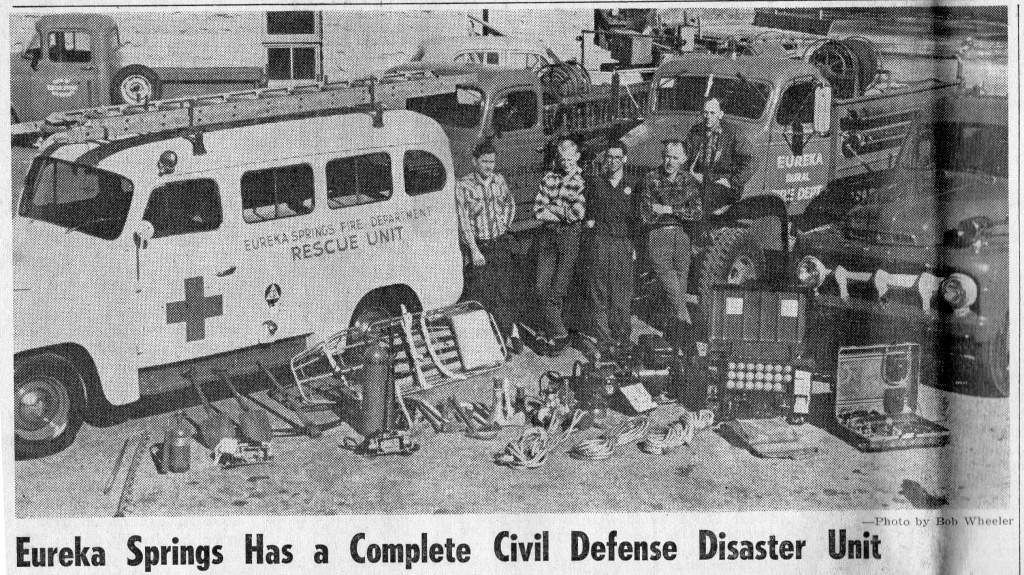
The first time I heard of the Premier Fire Apparatus Company of Eureka Springs, Arkansas is when Duane O’Connor mentioned that Tommy Walker had seen one of the company’s fire trucks in a museum in Sheridan, Arkansas. The reason that we were even on the topic was because I’d seen an obituary for Minnie Barbee that listed Duane O’Connor as a pallbearer. He told me that Minnie’s husband had owned the fire truck assembly plant that was located on White Street at the top of Owen.

Having learned the name “Barbee,” I did what I do: I searched for the name on the internet and looked it up in my paltry collection of reference books. It turns out that Minnie Barbee’s late husband was Roscoe Barbee and he was a big deal, both in Eureka Springs and in the region. He not only owned the Premier Fire Apparatus Company, but he was also in a partnership with Sam Leath for a number of years. (They owned Camp Leath, now the location of Inn of the Ozarks.) On a wider scale, Roscoe Barbee came from a family that was widely known in Missouri politics. Online, I found a copy of Roscoe Barbee’s 1942 Draft Card. From this, I learned that his middle name was Cleveland and that the odds of his being drafted for World War II were slim: he was 57 and had only one leg.

I then talked further with Duane O’Connor about Mr. Barbee and his fire truck company. He remembered hearing that the trucks were delivered to Eureka Springs without a body or cab before being outfitted into a fire truck. He recalled a story about one such truck being driven to town in the middle of winter and that the driver was covered with icicles when he arrived.

Tommy Walker kindly emailed me a photograph of the sign at the Grant County Museum that described the fire truck that he’d seen on display. It was a 1939 Chevrolet (with a six-cylinder engine) modified by the aforementioned Premier Fire Apparatus Company. The truck was purchased by the city of Sheridan in 1940 and was the first motorized fire truck in Grant County, Arkansas.

ES Independent Column – Trees

Lately, I’ve been thinking a lot about trees. I do that sometimes. What triggered it this time was a trip to the track behind the Eureka Springs Elementary School. A man stopped me to ask if I had ever seen a chinquapin tree. To be honest, I couldn’t remember if I’d ever seen one or not, but I’ve heard about them all my life. The man showed me one growing in the edge of the woods that skirt the track’s parking lot. He gave me details about the once ubiquitous Ozark Chinquapins and how they were wiped out by blight, similar to what happened to chestnut trees. This led me to thinking about trees and the local forest.

Trees have always been important to the western side of Carroll County. I believe that the beauty of our forested hills still help bring in tourists and the cutting of firewood and sawmilling still employ several on a part-time basis. Once upon a time though, this area was part of the largest white oak forest in the world. For decades, millions of trees were cut for stave bolts (for barrel making) and for railroad ties.

The 1870 Federal Census was the last census taken before the founding of Eureka Springs and the tourism industry that we now take for granted. Timber was king. If you skim down the occupations listed for the approximately 1,200 locals on this side of the Kings River, you’ll see many lumber jobs and ancillary occupations such as blacksmiths, teamsters, and farriers.

All of this thinking of trees led to the memory of a conversation I had with a lady in town years ago. She asked how I could be a tree hugger when my family had cleared more trees than any other family in the history of Eureka Springs. I don’t think that she was correct on either point, but I do like trees. There is a good reason why I don’t live out on the treeless plains or tundra. But, as much as I am fascinated by trees, I still burn them in the woodstove every winter.

ES Independent Column – Alex Weems

Alex Weems was born a farm boy in the green hills of east Tennessee. During the Civil War, he lied about his age and joined the Union Army at 14 years old. His cavalry unit was embroiled in three years of combat in several different states. Records indicate that Alex’s lifetime of poor health was linked to his time in the army. After the war, he returned to farming and married his sweetheart Margarett. Times were hard in Tennessee, so the family moved  several times, ending up in Salem, Kansas near the Nebraska border.

The harsh winter weather on the plains was difficult for Alex. The Weems family lived there when the Great Schoolhouse Blizzard of 1888 hit. The storm was especially destructive because the weather had been mild and many were caught unprepared. It is reported that hundreds became lost in whiteout conditions and froze to death, including many children who had been released from school just as the blizzard hit.

At the age of 42, Alex was declared an invalid by the War Department. Life continued though and not for the best. Alex and Margarett’s oldest son James died and was buried at Salem.

More than ready to leave this area of Kansas that had held so much difficulty, Alex got a break. A man by the name of Horton traveling through the area stopped and met Alex Weems and they got to talking. The man had an 80 acre farm on Keels Creek in Carroll County, Arkansas. The Ozarks must have sounded like the hills of Alex’s childhood. He traded his farm in Kansas for the farm near Eureka Springs sight unseen.

Alex and Margarett and their eight children travelled to Arkansas and settled into life on Keels Creek. Two more children were added to the crowded household and the older ones attended the Concord School. They later married into local families. Alex sold the farm to France Johnson in 1911 and the family moved to town. Alex and Margarett are buried in the Eureka Springs Cemetery.

Eureka Springs Independent Column

And so another class graduates from Eureka Springs High School and passes into legend. The graduation ceremony was held Friday, May 22 at the new high school gymnasium. It was announced that the 45 members of the graduating class of 2015 have already been awarded over $700,000 in college scholarships.

Also over the weekend, the Eureka Springs High School Alumni Association held its 125th annual banquet and meeting at the Inn of the Ozarks Convention Center.Chairing the meeting was Alumni President Rusty Dycus (Class of 1992).

Diane O’Connor Weems (Class of 1986) welcomed the newly graduated Class of 2015 as members of the Alumni Association. Diane’s daughter Sarah Weems (Class of 2015) responded by accepting the invitation on behalf of the graduating class.

Bobby Pyatt (Class of 1955) was presented the Alumnus of the Year Award by Jeff Reynerson (Class of 1974). Mr. Pyatt is one of the all-time great basketball players from Eureka Springs High School. In the days before the establishment of the three-point shot, he once scored 49 points in a single game. It was also reported that he has a passing resemblance to Cary Grant and is a true gentleman.

Phyllis Albrecht McGuire (Class of 1962) presented Juan Luis Palacios Romero (Class of 2015) with this year’s $1500 Alumni Association Scholarship after reading his excellent essay to the group.

When Ben Rivett (Class of 1964) stepped forward to call the roll of the members present, someone shouted that he was the “best bus driver ever.” I tried to keep track of how many names were called, and the unofficial total I arrived at was an even 100 alumni members present (plus their guests). The oldest class represented was the Class of 1942.

David Stoppel (Class of 1978) read the names of the 14 alumni who had passed away in the previous year.

Association Treasurer Tammy Sherman Bullock (Class of 1991) presented the financial report and Association Secretary Gayla Goff Wolfinbarger (Class of 1981) read the minutes of the 2014 meeting.

The meeting was adjourned after Thalia Colvin-Ortega (Class of 2015) won the Apple iPad.