Eureka Springs Independent Column

My obituary won’t boast that Steve Weems never met a stranger. I am not a master of social dynamics; I’ve never made friends easily.  I’m more comfortable observing than participating and I’ve been accused of being anti-social a number of times. And yet, inexplicably, I find myself having friends.

What all my friendships have in common is that I did not consciously choose them. In every case, I was brought together with someone by circumstance and a bond was formed. Perhaps I’m a little superstitious about the process. Some of my friends are blood relations, some date back to my time in school. Some are of more recent vintage, met through jobs or because of my writing one way or another. Some of my friends I met while in the military.

I had a buddy in the army from when I first arrived in Schwaebisch Gmuend, West Germany. He trained me in my job and we often worked through the night hours together. I still remember the intense feeling of freedom the day we rented a Volkswagen Golf and started driving without a single destination in mind. After an impromptu tour of the Augsburg Zoo, we became hopelessly lost in Bavaria. My friend was happy as long as he had cigarettes, so we drove until we hit Munich late at night and had to turn around and head back for duty.

Just like me, my friends are flawed. Just like me, my friends do things they shouldn’t. Sometimes friends will do something that will turn your soul to ice. My buddy returned home from a tour of Iraq and murdered his wife and then committed suicide on the front lawn while his children played inside the house. Ever since that event I’ve wrestled with questions of friendship and what it means, like when is it correct to end a friendship? What is the tipping point? In this case, my buddy is already dead. Too late to disown him, except in my mind. And yet, despite his actions, I continue to feel loyalty to him. Is that wrong? I do not know.
Eureka Springs Independent Column – Joe Parkhill

I was around Joe Parkhill a few times as a teenager. He was an older man then and he’d usually be reading the newspaper. On one visit to his home, I recall that he’d just returned from a trip to Dallas to visit Tom Landry, the head coach of the Dallas Cowboys football team. I asked his step-daughter Linda recently if my recollection was correct. She said it was and that because of Joe’s relationship with Coach Landry, the players on the Cowboys team each ate a honey stick before games for a burst of energy.

Joe Parkhill was born in Eureka Springs in 1911, but grew up in Chicago. His grandfather was a barber whose parents had emigrated from Ireland. His grandmother was a sister to Claude Fuller.

When my father was Station Keeper at the Naval Reserve on Spring Street in the early 1960s, Joe Parkhill was also a member of the unit. I’ve heard the story that if something was needed that couldn’t be acquired through official channels, Joe might work his magic. After a trip somewhere, he’d show up bearing gifts. Joe Parkhill could wheel and deal with the best of them.

At some point, Joe Parkhill fell in love with honey bees. He was appointed director of the Arkansas Apiary (Bee) Board by Governor Faubus and he ran with it. He crisscrossed the state promoting honey bees and it is said that during his tenure, Arkansas went from last place in the nation in honey production to eighth place. He pushed through the honey bee becoming the state insect of Arkansas. A natural at marketing, Joe had a radio show and appeared on television. He compiled several honey cookbooks and served as President of the American Beekeeping Federation. He lectured in Japan and travelled to the Soviet Union to represent the United States bee industry.

I’ve barely scratched the surface. I’ve left out his rumored link to Al Capone and the slot machines at the Basin Park Hotel, and his friendships with characters ranging from Jim Bakker to Bill Clinton. And, of course, he played the drums.

Eureka Springs Independent Column

With the fragrance of lilacs flirting with my nose, I lay open the April 27, 1967 edition of the Eureka Springs Times-Echo. The lead story is the upcoming county-wide vote on issuing bonds to fund the construction of a $720,000 hospital in Berryville. There is a full-page advertisement signed by 84 local residents against it, and a quarter-page advertisement in favor of the bonds. I guess we know how the election turned out.

Of course, Holiday Island wasn’t always called Holiday Island, but did you know it was once called Hollydale Island? I didn’t. A front page article announces the change of name from Banach Island to Hollydale Island. This makes sense because the 4800-acre property that includes the island was owned by the Holly Corporation of California.

Reby Nelson’s house on East Mountain burned down and both she and her daughter Rose Brown were hospitalized with burns. Reby Nelson was my wife’s great-grandmother.

Two spelunkers exploring Onyx Cave at the invitation of owner Ralph Schmidt discovered 425 additional feet of passageways and an underground waterfall. J.D. Fletcher and family purchased the Devil’s Dive Resort on Table Rock Lake. Mr. and Mrs. Cecil R. (Pete) Birchfield are congratulated on the April 20th birth of their daughter Stephanie Lynn. The Eureka Drug Company is having a close out sale on all record albums, including their one remaining copy of the very popular The Sound of Music.

Local family doctor Ross Van Pelt spoke to the high school on the dangers of using narcotics not prescribed by a physician. He especially warned against falling prey to heroin.

In Berryville, both the Oklahoma Tire & Supply and the Ben Franklin Store are selling all their merchandise and fixtures and calling it quits. Also in Berryville one can attend showings of A Fine Madness starring Sean Connery and Joanne Woodward.

The US Army is in need of volunteers, especially those with previous military experience. The recruiters in Fayetteville say to call collect if interested in joining up.

And so I close the April, 1967 newspaper and take a moment to admire the blossoming redbud trees on the hill.

Eureka Springs Independent Column

The way I heard it, it was about 1937 when Burt Hull lost his hand in the sawmill accident. He was cleaning sawdust out from under the machine when he raised his hand and the spinning blade caught it. His son Curtis rushed him to the Eureka Springs Hospital in a Model A Ford. That night, Burt was unable to sleep because he could feel worms eating into the severed hand. He had Curtis go back to the sawmill, collect the hand from the sawdust pile, and bury it.

I don’t remember ever seeing Burt Hull, but he’s one of those people I’ve heard about all my life. As a kid, stories of a one-handed sawmill operator grabbed my attention. I understand from the stories that he could do as much work or more with a hook than others could do with a fully functioning hand.

I ran across an article about Burt Hull in a 1975 Carroll County Historical Society Quarterly magazine, written by Coy Logan shortly before Mr. Hull’s death. As I expected, his first job off the farm was sawmilling for Franzisca Massman down at the bottom of Oil Springs Road. But, it turns out that Burt Hull was much more than just a hook-handed saw miller. He was a butcher, a blacksmith, an entrepreneur, and a progressive farmer intrigued by modernization and machinery.

Always for trying new things and for improving what he had, Burt Hull invested $175 in a Case steam tractor as a young man. He bought it up in Joplin and had to get it back to Arkansas. He and his brother and a cousin drove the machine home, gathering wood along the way to fire the engine and hauling water in a barrel for the steam. At night, they’d camp by the side of the road. It took seven days to drive the contraption home from Joplin to Eureka Springs.

Like many in the Hull family, Burt is buried in the Shady Grove Cemetery east of Eureka Springs not far from where he grew up on Kings River.

Eureka Springs Independent Column

Milton Wright Masters and his wife Melany bought 338 acres of hills and hollows just outside Eureka Springs in 1927 for $700. Mr. Masters is reported to have been a kind, progressive man. At a time when children were seen more than heard, he encouraged conversation with them at the dinner table.

We have a small part of his farm. Our little farmhouse in the hollow was built about 75 years ago as a replacement for a much larger home of his which had burned. Besides the house, we also have the barn and other outbuildings. The main spring behind our house is said to have never gone dry and it supplies our water, just as it did for the Masters family.

Before there was electricity at the farm, Mr. Masters built a spring house to cool their food and farm products. He had several kinds of livestock and grew various types of produce, everything from potatoes to apples. The Masters were especially known for their strawberries and people came from miles around to pick their own or to buy from the family. During the Great Depression, when the farm wasn’t paying enough to get by, Mr. Masters took employment at the ice plant in Eureka Springs. He worked the night shift and farmed during the day. Because it was summer and he had a house full of kids, he had trouble getting any sleep. Luckily, down the hollow is a small cave under a sizable bluff. Milton Masters put a bed in the cave and had a nice cool quiet spot to rest.

My understanding is that the original home built by Milton Masters was out of materials from a boarding house torn down in Eureka Springs. The rebuilt home was supposed to be quite a place, two stories tall with large rooms and an impressive staircase. The only problem was that the building materials had been infested with bedbugs. Melany Masters fought the bedbugs over years in every way known to man. Later when the house caught fire and burned down, Melany is reported to have said, “Well, at least we got rid of the bedbugs.”

Eureka Springs Independent Column

In the spring flowing behind our house, there are little bitty crawdads. I’ve not seen one for awhile, but I trust that they are still lurking in the water. I’m glad that they are there, as I’ve read that crawdads are an indicator of healthy water. As you probably know, if you played in creeks as a kid, crawdads are small crustaceans, miniature freshwater lobsters with pincers. Though usually called crawdads in the Ozarks’ vernacular, they’re also called crayfish, crawfish and mudbugs.

When I was young, my Uncle Dana Scott came over from Rogers and took some of us out to catch crawdads. The way I recall it, we walked several creeks that day carrying buckets, looking under rocks and logs until we’d caught a mess of them to eat. We used our hands to catch them and, with practice, I didn’t get pinched. Dana cooked them up and they were quite tasty.

There are supposed to be approximately 60 different species of crawdads in Arkansas, and most are found in the cold springs and creeks of either the Ozarks or the Ouachitas. They come in a variety of sizes and colors: the ones in my spring are brown and smaller than two inches. Bigger ones can also be found, though.

Local outdoorsman Jared Mourglia has caught crawdads in the 8 inch range. Wearing goggles, he dove into Kings River and captured them by hand under the piers of the old US 62 bridge. I believe crawdads that large would have to be the long-pincered variety that are found only in the White River Basin of Arkansas and Missouri. I’ve read that some experts say the long-pincered crawdad is the largest in North America. While catching crawdads by hand is always an option, I’ve heard of others locally using baited traps to capture these big crawdads by the dozen.

Though commercial operations are more common in Louisiana, Arkansas does have crawdad farms. The crawdads are raised as food and, prepared correctly,  they not only taste great, but are very high in Vitamin B12, which is essential for proper brain function.

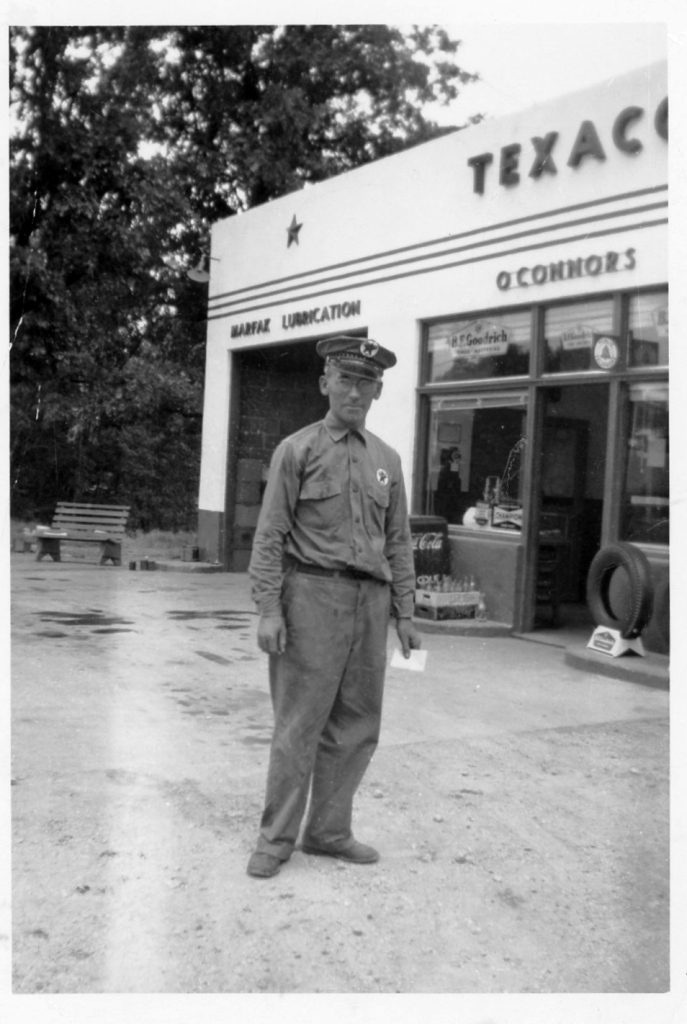
George O’Connor

This photograph of George O’Connor of Eureka Springs, Arkansas was taken November 25, 1950. He is standing in front of his business, O’Connor’s Texaco Service Station. He was 49 years old. This photograph was provided by Susan Willard of Kansas. It was on November 25, 1950 that George O’Connor, a Justice of the Peace, married her parents.

George OConnor 1950

Eureka Springs Independent Column

If you know my Uncle Arlie Weems, then you probably know that he conducts morning office hours at the top of Stadium Road and has done so for as long as I can remember. His office is his Chevy pickup. Anyone can pull up and roll down their window, or maybe stand around depending on the weather and other factors. There are some gravel piles and usually a dump truck and backhoe there.

If you don’t know Arlie, then you need to know that he has the reputation as a virtuoso with a backhoe. I’ve been told several times by various people over the years that he is an artist when using his machines.

On this particular day, I wanted to ask him what year he drank his first can of Mountain Dew: I was thinking about writing a column about the beverage. I’ve always associated Mountain Dew (the carbonated version) with the Arkansas Ozarks. As a kid, I don’t recall people drinking Mountain Dew in the Washington DC suburbs, or overseas, but when we’d come home to visit, there’d be someone drinking it. Often, it was Arlie.

So I asked him my question and the answer was this: in about 1965, a man named Nolan Brisco was driving the Pepsi truck out of Harrison and he stopped at the DX station where Arlie was working and gave him a free sample of Mountain Dew. Arlie has been drinking it ever since. The DX was the service station located about where the Subway is now on US Highway 62. Nolan Brisco is still around. He owns ABC Signs and Advertising in Harrison.

The other interesting thing we talked about was a prior day’s event that occurred south of town. Arlie had been backing a Mack dump truck when it inexplicably wouldn’t stop. He tried all the tricks a person with 50 years experience knows, but nothing slowed it down. After the truck turned over, he climbed out. He said he wasn’t really shook up, unlike the first time he flipped a vehicle several decades ago. It wasn’t his first rodeo, as they say.

Eureka Springs Independent Column

On December 6, 1993, I stopped by my grandparents’ farm for a minute. I was home from college and I made notes of my visit that day, not because it was extraordinary, but because it was typical. Jack and Betty McCall believed in hard work and expected everyone in the family to pitch in and help. I knew I ran the risk of having to help with chores.

Just after I arrived, Uncle Arlie Weems drove up in a dump truck and dropped a load of gravel for the farm lane leading to the county road. Though I thought I was in a hurry, I ended up helping Betty smooth gravel for two hours. She was just shy of 80 at the time, but she worked me into the ground. She invited me to stay for lunch.

Jack’s health was deteriorating, but he still had work that had to be accomplished, so after we ate, I changed the spark plugs in his Ford pickup. Since the hood was up, he had me replace a radiator hose, too. He decided he needed some O-rings, so we left for town. At the highway, the carburetor kept flooding, so we stopped and put the hood up again. Shade Hadley stopped and helped, but we still were unable to diagnose the problem. Since we were blocking traffic on Rock Springs Road, Jack rolled the truck backwards down the road until it would roll no more.

Betty happened to drive by and stopped and picked up Jack. He returned, chugging along on his ancient Farmall tractor and towed the pickup back to the farm. He still wanted O-rings, so I drove him to Kimes in my vehicle. When we arrived back at the farm, Jack called his son Sherall, a mechanic, and was told to blow out the carburetor as there might be trash in it not allowing the needle to seat. That fixed it. By then it was time to put out hay for the cattle. I left tired and dirty, but feeling good. At the time, it never occurred to me that days like that would come to an end on the McCall farm.

Old Bridge Over the Kings River

This old postcard depicts the US 62 highway bridge that once crossed the Kings River between the Arkansas cities of Eureka Springs and Berryville. It was sometimes dangerous because of its narrowness, but I still miss it. The new bridge is five lanes wide and undoubtedly safer but its also ugly. With its elegant arches, I thought the bridge on the postcard was a beautiful structure. I don’t know what year the old bridge was dedicated, but at the ribbon cutting, Jack McCall rode the first horse across it.

Kings River Bridge postcard

Eureka Springs Independent Column

Ray Freeman of Eureka Springs, Arkansas was known for his honesty and integrity. Toward the end of his life, he had O’Connor’s Texaco (now the location of Sparky’s) service his automobile. When the work was completed,  Doris O’Connor returned the car to Mr. Freeman. What she didn’t realize is that she had accidentally left the Texaco’s bank deposit on the front seat of Ray’s vehicle. Duane O’Connor said that if you had to leave a bag of your money in someone’s car, you couldn’t find a safer person to leave it with than Ray Freeman.

Ray Freeman and his wife Chloe moved to Eureka Springs in 1921 soon after the birth of their son Bob and while their other son Charles was a toddler. Though new residents to Eureka Springs, Ray was a member of a historic family that had long played a prominent role in the affairs of Berryville and Carroll County.

Quite successful, Ray Freeman stayed active in the business world. A sampling of his endeavors include the grocery business, partnering with Eagle Thomas in a variety of entrepreneurial pursuits (including Onyx Cave), and operating cabins on the White River. He later founded Camp Joy, which evolved into the Joy Motel. He was a mayor of Eureka Springs and a charter member of the local Rotary Club. He also leased Lake Leatherwood.

The infamous Dr. Norman Baker once started a feud with Ray Freeman over integrity. He lived to regret it. Apparently, the Freemans had warned visitors away from becoming patients at Baker’s cancer hospital. In a open letter published in the Daily Times-Echo newspaper on June 15, 1939, Dr. Baker retaliated by accusing Mr. and Mrs. Ray Freeman of damaging the economy of Eureka Springs. The long letter had “language tending to impeach the honesty, integrity, veracity and reputation” of the Freemans, according to the charges brought against Dr. Baker by the prosecuting attorney. Norman Baker fought the charges tooth and nail at every level, but, in the end, the Arkansas Supreme Court ruled that he was guilty of libel and upheld the fine of $2,500 (equal to roughly $42,000 today).